Showing posts with label contemporary art. Show all posts

Thursday, 10 December 2009

100days of Art: Day Eight - Mistakes and Expectations


Marc Quinn - Stuart Penn (2000)

Art Historians make mistakes. It goes with the territory, paintings like The Massacre of the Innocents get attributed to the wrong artist, new evidence comes to light and completely turns received wisdom about a sculpture on its head; it all part and parcel of dealing with a subject that attempts to knit together a coherent story out of a mass of uncertainties, contradictions and, on occasions, downright lies. (The dates that Kasmir Malevich inscribed on his Black Square paintings being an example of the latter – though to be fair he was as mad as a bag of badgers in a spin dryer.)

Since the discipline took lessons from the likes of Foucault and Barthes and developed doubt into a valid ideological position, negotiating the potholes and chicanes of art history is slightly easier – in the first year of study, the student art historian learns the magic word ‘problematic’, a useful means of tying up the flailing loose ends of a tricky paper. You can even use it as a verb, “This is of course problematicised by…” It’s a cop out really, but a necessary one, without it you’d never finish an essay.

Sometimes the repercussions of these mistakes only affect the rarefied circle of art history itself, tiny ripples in a small pond, a few papers may have to be re-written, some textbooks and monographs may fall out of favour and conferences will be arranged. Other times these ripples can have wider implications changing the direction that art and culture take and influencing the nature of public taste.

For centuries, art historians and theorists held up Classical Sculptures as exemplars or quality and ideal beauty; painters copied figures from them, sculptors worked hard to reproduce their style in their own work and the young men of wealthy families were sent off on Grand Tours to view them to distract them from deflowering the chambermaids for a few months. If the philosophers and politicians of Athens and Rome favoured such sculpture, so should younger societies aiming for a return to the artistic glories of those once great civilisations. Almost subliminally the notion that the very best sculpture was carved from white marble sank into the Western cultural consciousness. And even by the time that Modernists, like Barbara Hepworth were making abstract sculpture, white marble was still seen as a prestige material.

Yet recent scientific investigations of sculptures such as the Parthenon Marbles have revealed traces of pigment and there’s now a consensus that they were extremely brightly painted and adorned with all manner of jewellery and accessories. So it seems that a few hundred years in the development of ideas of what is beautiful, sophisticated and above all tasteful were in a large part based on a whopping great art historical mistake.

We still feel the influence of this mistake today. Take a look at Antonio Canova’s Cupid and Psyche and imagine how different about it you might feel if it was more like Jeff Koons’s Michael Jackson and Bubbles. Even though I know that there’s a great big misunderstanding lurking at the heart of Canova’s aesthetic decisions, I can’t help thinking it would look hideous if it was a gaudy as the Koons. The association of white marble with grace and beauty remains so deeply ingrained that even a few colourful revelations can’t shift it.

Marc Quinn made great use of this association in a series of sculptures he made in 2000. Take a look at Stuart Penn above, it seems at first glance like any other classically influenced sculpture, and when the series were exhibited in the sculpture rooms at the Victoria and Albert museum, they seemed right at home amongst the 16th to 18th century figures, if anything a casual viewer might have been led to believe they were in fact older than Canovas and Bolognas by virtue of the missing limbs.

It’s the missing limbs here that are key. Quinn’s models for the series were sitters who had either been born missing limbs or had lost them due to accident or disease. So used are we to seeing classical sculpture fragmented and damaged that an absent arm or leg is part of our expectations of work like this. We edit out the vacant limbs of the Venus De Milo to look at her beauty, and that’s exactly how we react to Stuart Penn. Among the stone pantheon of gods, athletes and heroes we look past his physiological differences and see his beauty.

Quinn’s marbles are overwhelmingly positive and uplifting. It’s a stunningly clever trick to mobilise the centuries-old prejudices of history and taste to both defeat and draw attention to those of the present and to subtly use our expectations of art to challenge our perceptions of real people.

So here’s raising a glass to the mistakes of art history (no matter how problematic they are).

Wednesday, 9 December 2009

100days of Art: Day Seven - Clutter and Cardigans

Cornelia Parker - Pornographic Drawings (1996)

De-cluttering before moving house with me can be a painful business. Left to his own devices Pete will quite happily clear a drawer in 30 seconds flat leaving nothing but a couple of paperclips and a teaspoon. The ‘left to his own devices’ here is key because if I’m within a mile-radius of him as he goes to throw away a long-dead lighter, some sixth-sense kicks in and I’ll be at his shoulder before his hand’s out of the drawer.

“You can’t throw that away.”

“But it’s a dead lighter.”

“Yes, but look, we bought that in Amsterdam..”

“But it’s a dead lighter.”

“Yes, but we bought it that night we got lost in the rain ‘cos all the canals looked the same.”

“But. It’s. A. Dead. Lighter.”

This continues for some time until I get distracted by something shiny and Pete throws the lighter away anyway.

Objects have memories.

Or rather, to be uncharacteristically rational about it, we attach our memories to objects. Relics of our past become mnemonics for whole events, a dead disposable lighter starts a domino-topple of remembered sensations that leads to a hazy giggly night negotiating canals in the rain.

Such associations and leaps of logic seem hard-wired into us, we don’t even need to have direct personal experience of the object to be affected by a real or imagined history that it might have somehow woven into its fabric. In his book Supersense Psychologist Bruce Hood describes a neat trick that he uses in his lectures to show that even the most rational skeptic can find themselves in the grip of supernatural belief. Holding up a tatty cardigan, Bruce asks the audience how many would, for a fee of £20 be willing to wear the moth-eaten garment. A few of the audience raise their hands. When however Bruce reveals that the cardigan once belonged to the serial killer Fred West, the potential volunteers invariable lower their hands. The cardigan didn’t belong to Fred West of course, but Bruce’s little prank illustrates the way in which we almost subconsciously imbue objects and materials with meaning beyond their intrinsic properties. In the case of the ‘killer’s cardigan’ it’s an example of what James Frazer defined in The Golden Bough as ‘contagious magic’, by contact with evil, the cardigan itself has become contaminated with evil.

Cornelia Parker works with found objects and through display, transformation or destruction she amplifies, distorts or reverses their contagious memories and meanings, anchoring a web of ambiguous ideas to physical properties. Sometimes these works are minimal, abject objects displayed in vitrines whose significances only become apparent when we look at the label to find out what they’re made of – a pair of dusty earplug are made from fluff gathered from the Whispering Gallery of St Pauls Cathedral, a pile of black plastic fingernail clippings entitled ‘The Negative of Sound” turns out to be the cast off lacquer cut at Abbey Road Studio from the grooves of master disc for a vinyl record, a stain on a handkerchief is the tarnish gathered from the inside of one of Henry VIII’s gauntlets and so on. Other works are monumental, for Cold Dark Matter: An Exploded View the artist filled a garden shed with household objects and toys before getting the British army to blow it up, the resulting debris now hangs orbiting a light bulb casting shadows on the walls of the gallery space, the moment of the explosion frozen in time.

Pornographic Drawings is a favourite of mine, at first glance it seems to be a collection of Rorschach Ink Blot tests, we peer at them looking for images in the abstract splodges, recreating their very purpose. The title leads us to search for erotic imagery and in two it doesn’t take much of a stretch to find phallic and vulval forms. The other two are more perplexing, there’s suggestions of eroticism certainly but but nowhere as obvious as the first two or have we just got one-track minds?

Already the work is questioning the status of the images and our process of looking at them, psychoanalysed by the blobs in front of you, you can’t help wondering if you’re missing something. Given that two of them seem so explicit, are we failing to notice erotic content in the others that the artist has seen, is pornography in the eye of the beholder?

The situation become both clearer and more confused when we discover the materials used to make the images. Working with Customs and Excise, Parker took shredded video tape form confiscated pornographic videos and created an ink from the Ferric Oxide that gave the tape its magnetic and therefore recording properties. The ink was made from the very physical matter of pornography, the images were therefore erotic both by virtue of what we might see in them, but also by virtue of their material. Of course you could argue that the original film images are long gone, if we were to slide the drawings across the head of a VCR we wouldn’t see ‘adult entertainment’ (and we’d probably get chucked out of the Tate) but the point is that’s it’s our memory that’s at work here. Once we know the origin of the ink, we can’t forget it and our view of the images is irrevocably changed. Somewhere in our minds that contagious magic is at work, as if the very molecules of Ferric Oxide are ‘contaminated’ with the images they once carried, in the same way that the work’s title and our knowledge of the use of Rorschach blots contaminated our first encounter.

It’s a cliché that good art should change the way you look at the world. For me Cornelia Parkers’s work does exactly that. After visiting one of her shows the most ordinary of objects become fascinating artefacts bursting with meaning, memories and stories.

Now if you’ll excuse me, I can hear Pete rummaging in a drawer, he might be about to throw away one of those stories.

Tuesday, 8 December 2009

100days of Art: Day Six - Silent Running


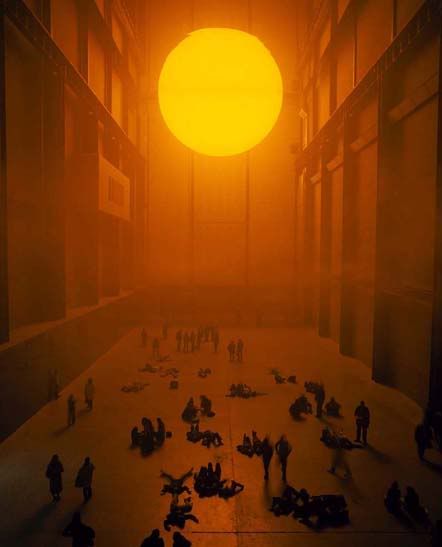
Olafur Eliasson - The Weather Project (2003)


“How are you doing?”

I opened my eyes to see Pete standing above me , packing away his camera.

“Fantastic thanks. “ I said. “You get any good shots?”

“Well I’ve taken tonnes, should have a couple of good ones. Did you see that lot?”

He pointed towards a group of teenagers who were lying flat on their backs in a circle, legs splayed and feet touching. They cheered at the star they’d created on the mirrored sky above them.

Around us children ran in circles, squealing with joy as their parents sat quietly smiling and watching their offspring’s delighted confusion. Club goers, commuters, tourists and Southwark locals sat in groups chatting quietly in the intense yellow light or stood gazing through the mist at the vast disc of light that seemed to hover above us.

Olafur Eliasson’s installation The Weather Project had really caught the public’s attention and imagination, over the weeks that followed it’s unveiling, friends who worked in the area talked of lunchtime trips to Tate Modern during the week ‘to get a bit of sun’ It was a work that somehow created a community of its own around itself by creating an odd little bubble of unreality in which encounters could take place. As vast and technically breathtaking (as an example of electrics and engineering) as it was, it transformed and dominated the Turbine Hall not by occupying and subordinating it – as Anish Kapoor’s Marsyas had a year previously, but by changing the nature and environmental qualities of the space.

Using as familiar a subject as a sunset, I think, also explained the works popularity. It’s a subject we’re all familiar with from holiday snaps and children’s TV art programmes (I seem to remember that the late great Tony Hart would teach us how to make at least one sunset per series of Take Hart.) In the real world it something we’ve all experienced and it appeals to something primal inside us; the end of the day, the dying of the Sun God, the sublime – however you want to frame it. As a retreat from the grey, damp and dismal London weather, it felt like a grand Romantic gesture – a technological updating of works like Frederic Edwin Church’s Cotapaxi that had hung in Tate Britain a few months earlier as part of a show celebrating 19th Century American landscape painters.

But for all the play and fun it brought out in the visitors, there was a perhaps a more Apocalyptic aspect to the work. The monotone lamps obliterating every colour in the room apart from the all pervading sickly yellow gave the space a distinctly alien feel, for all its technical wizardry it felt old and dying, a natural phenomena taken from somewhere else and frozen in a gallery as a museum piece. To my mind, drenched in science fiction as well as art history, I couldn’t help thinking of the 1972 film Silent Running, where the last remaining plant specimens of a dying earth are jettisoned into space. Viewed in the context of Climate Change could The Weather Project be a glimpse into a future where the only place we could experience a sunset would be in a museum, or maybe a society where the only weather we would have would be artifical? I imagined that the people around me would soon leave to walk down gleaming white corridors of a 2001 style space station or some colony base on an inhospitable world to sterile living quarters where they’d dine on protein pills and filtered water. To my mind the work now seemed like a meeting between John Martin and J.G.Ballard.

Perhaps I was being too pessimistic, perhaps if anything The Weather Project suggested that humans will always respond to natural beauty and that we’ll always find a way to take it with us whether it’s a photograph or a vast installation. Perhaps my imaginary future folk had created this as a reminder of home, not as a memorial to it.

“Hello. Planet Earth calling.”

I shook myself out of my geeky reverie.

“Sorry – miles away.”

“Come on, lets go.”

We wrapped our coats tight around us and walked out into the driving autumn rain on the darkening South Bank.

“Of course” said Pete “It could have done with some robots..”

Thursday, 29 October 2009

An Apology To Veronica Read


When we lived in London, a yearly ritual was for us to take my mother to the Tate. These visits invariably followed a set itinerary, we’d weave our way through the exhibits I'd get excited by the various new contemporary works on show and rambling about art history while my mum would make non-committal umming noises. Eventually one of two things would happen, either my mum’s patience with “this sort of nonsense” would run out, sending Pete scurrying to hide behind a Damien Hirst to avoid being associated with the fierce exchange of views that would then ensue, or she would amaze us both by suddenly getting incredible enthusiastic about something that both Pete and I would have thought fell firmly into her ‘this sort of nonsense category.


In 2002 one such piece to inspire a cessation of hostilities was The 4 Seasons of Veronica Read by Turkish installation artist Kutlug Ataman. Four screens hung in the obligatory darkened space, across which a series of face to camera interviews were conducted with the eponymous Veronica, a collector and expert cultivator of Amaryllis plants, which charted her life across a year. What fascinated us was the way in which Veronica’s emotional and physical state seemed to be inextricably linked to the seasons and to the wellbeing of her plants. In Spring she was gleeful and bursting with enthusiasm showing off her plants with the pride of a new mother. In Winter she was more sombre and guarded, seemingly uncomfortable with the whole process and when an infestation of mites devastated her plants she seemed to disintegrate in front of us.

At the time it struck me as a document of a particularly English piece of eccentricity, of becoming so involved in a passion that it takes over your life. Having said that I must confess I’ve always been affected by the seasons, never quite to the extent of those who suffer from Seasonal Affective Disorder, but there is a fundamental shift that takes place in my nature when the clocks go back or forward. It’s manifested in the books I read, the music I listen to, the food I want to eat. From March to September I’m a Mad March hare guzzling Woodehouse, Waugh and Harry Potter, my Ipod sparkles with The Byrds, The Stone Roses and three minute pop songs, I munch mountains of fruit and crave the bustle of the South Bank or Bristol’s Floating Harbour. Come the winter and I transform into an altogether more serious animal, my bedside table groans under the weight of worthy tomes of non-fiction, horror and crime novels, my musical tastes become glacial and minimal, Coil, the Aphex Twin, Nyman and Glass soundtrack my ventures into the outside world where routes are planned to avoid as many people as is humanly possible.

Don’t get me wrong I don’t get miserable or maudlin – a touch more grumpy and prone to ranting perhaps, but I actually generally like winter. I love the crunch of frost under my feet, the interesting shapes of skeletal trees. I even love fog. I just get..well, different I suppose. The tricky bit though has always been the transition from one state to another – a few weeks of borderline multiple personality disorder that my beloved other half has to weather with good humour, never quite knowing whether he’s going to come home to a garrulous chatterbox full of gossip and babble or a misanthropic reptile curled up on the sofa spitting venom at News 24.

But now, for the first time in my life I’ve got a garden, and I’m beginning to understand Veronica Read. Previously my horticultural record has not been good, houseplants would wither before my eyes in shops if I even entertained the notion of buying them. Over the years I’ve left a trail of dead yukkas, cheeseplants and kitchen herbs in my wake. I even once managed to murder a cactus. But now on Windmill Hill I have a vegetable patch – and it not only has living things in it, it has edible things in it and I’ve become obsessed. Gardener’s Question Time is no longer something that burbles quietly away unnoticed in the background like a spoken word Orb album, I actually listen to what’s being said and take notes. Every day brings a new little triumph, or defeat whose impact on my state of mind is far greater than I ever could have imagined. Yesterday I discovered that the slugs has decimated a couple of my dwarf bean plants and I was in a foul mood for the rest of the day – this wasn’t particularly helped by the fact that the shops, in their wisdom, have now put all their gardening merchandise away for the winter to make way for aisles and aisles of Christmas tat (Do garden pests take the winter off? Can I kill slugs with tinsel?) Today though, the sight of my first purple floret of sprouting broccoli poking it’s way through the leaves put such a spring in my step that I’ve been incredibly productive today.

So Veronica, my apologies for branding you as eccentric all those years ago, my green-fingered passions may only just be beginning, and I’ll never reach your levels of expertise (I doubt very much that I’ll ever cultivate anything that will win a gold medal) but now I understand. Oh and to my long suffering other half – if you want to know whether you’re going to be greeted by Jekyll or Hyde when you come home, check the garden before you step through the door.