Showing posts with label Florence. Show all posts

Wednesday, 16 December 2009

100days of Art: Day Eleven - And Now For Something Completely Different.

Bronzino - An Allegory with Venus and Cupid. (c.1545)

Sometimes a piece of information comes your way that irrevocably changes the way you look at a work of art. Take for example Vincent Van Gogh’s Sunflowers; stand behind some gallery visitors admiring it in the National Gallery and you’ll inevitably hear one of two things.

First that Van Gogh was a lunatic who cut off his own ear. People look for clues in the work and usually come the conclusion that you can somehow ‘see’ this madness in the painting; it’s fevered brush strokes and it’s obsessive yellowness seen somehow as a means of diagnosing the mental state of the artist. Of course this is a clumsy connection to draw – if thick impasto brushstrokes were a symptom of mental illness then Frank Auerbach would have been sectioned long ago.

The other thing that is commonly heard in front of the Sunflowers is discussion of the vast price that was paid for the work at auction – even though it was in fact a different version of the painting that set records in 1987.

Both these pieces of information, although not entirely accurate, affect the viewing of the painting by being part of the Van Gogh myth. The myth plays as much a part in the creating the meaning of the painting as do the historical facts of its manufacture.

Sometimes though, these snippets of information can be so far removed and apparently irrelevant to the work yet still change the way you see an artwork forever.

I’d always been intrigued by Bronzino’s An Allegory with Venus and Cupid, amongst all the nudes in the National Gallery, this strange depiction of Venus and Cupid in a lover’s embrace seemed a bawdy and shocking painting and it’s worth considering what headlines might be produced if a contemporary artist created a work depicting a similar subject. Even at the time of it’s acquisition by the National in 1860, Charles Eastlake, the then director of the gallery, took steps to make it ‘safe’ for public viewing by having certain details hidden by the addition of strategically placed branches of myrtle and by deleting, by overpainting, Venus’s tongue, which contemporary viewers can see slipping into her sons mouth. There was even much discussion about how the painting should be titled, An Allegory with Venus and Cupid finally being chosen as a neutral designation that would avoid drawing too much attention to the incestuous scene.

But more than that, what continues to fascinate about Brozino’s canvas is the sheer lack of information that exists about it. All that’s known is that it was commissioned as a gift for King Francis I of France, most probably by Cosimo I de Medici. Beyond that we know practically nothing and consequently the symbolic meaning of the painting and its strange cast of characters is something that art historians will enthusiastically disagree with each other about from now until doomsday.

The haggard, screaming figure to the left of Cupid, for example, has variously been identified as Despair, Jealousy or even in some account a personification of the ravages of syphilis. The female child to Venus’s right, who attempts to hide her scaled and feathered body behind the boy throwing rose petals and offering a dripping honeycomb to the lovers, may be Pleasure or Fraud. Everything in the painting is loaded with symbolism and meaning, the fact that Venus is grabbing one of Cupid’s arrows, the Golden Apple that she holds and the masks of comedy and tragedy that lie abandoned at her feet.

It’s a great puzzle of a painting, and one that more than likely will never be solved. But there’s one piece of information about the painting that has nothing to do with its life in 16th century Florence or France, that has nothing to do with the riddle of its symbolism or the negotiations that Eastlake and his team of restorers went through to avoid its display bring about the moral collapse of Victorian gallery visitors.

When I stand in front of this painting the first thing I notice now is Cupid’s right foot in the bottom left hand corner of the picture, seemingly about to trample on a dove. Take a close look – have you seen that foot before somewhere? Do you find yourself humming the opening bars of Sousa’s Liberty Bell? Perhaps you start thinking of dead parrots and transvestite lumberjacks.

It’s the foot that squishes down in Terry Gilliam’s opening animation sequence for Monty Python’s Flying Circus.

Of course it’s got nothing to do with the meaning of the work in any rigorously academic way, but it does add to my enjoyment of the painting. It’s cheeky little detail in an already cheeky image; a subversive little footnote (sorry) to an already subversive painting and one that goes to show that the story of an artwork doesn’t end once it’s hung in a gallery.

Friday, 4 December 2009

100days of Art:Day Four - Sometimes a Lance is Just a Lance (but in this case it probably isn't)


Sandro Botticelli - Venus and Mars (c.1483)

Frank Zappa once posed the question ‘Does humour belong in music?” Given that the album in question contained the song Penguin in Bondage, it’s pretty clear that in the mind of the late lamented pointy-bearded musical loon/genius and Czech cultural attaché the answer was a resounding ‘yes’.

Although music was Frank’s target, the question can and should be applied across the arts and that great big ‘yes’ goes across the board, the canon of ‘great paintings’ included.

For example I find Ingres’s Angelica Saved by Ruggerio absolutely hilarious, largely due to the expression on Angelica’s face which seems to have fallen backward through time from a Beryl Cook painting, I can never decide whether she’s thinking “About time too.”, “Oh no not you again.” or “Watch what you’re doing with that bloody lance.” The great thing is that the more detailed analysis you apply the funnier it gets – I once spent a joyful half hour in front of it with a well-respected lecturer in Art History and Gender Studies whose psychoanalytic interpretation had tears of laughter streaming down my face and brought gasps of shock from a coach party from the Batley Guild of Disapproving Women who were tutting around us like a flock of tweed starlings. ( I wont go into the details but the shape of the rock that Angelica’s chained to had a starring role.)

So, if art is so funny, why do galleries echo with hushed whispers rather than gales of bawdy laughter? Simply because it’s the way the gallery space encourages us to behave. Carefully spaced and meticulously lit, hanging in neat rows or arranged on plinths, painting and sculptures are presented to us as sacrosanct objects and we respond in quiet reverence.

This is all well and good, I like a nice empty gallery, I like being able to sit quietly and lose myself in a work of art cloistered away from the noise of the city. (Anyone who’s been in a gallery with me will have noticed me grinding my teeth if someone’s mobile phone starts to ring).

But displaying work in this way also has the effect of separating the work from the life it once had. It’s true that much of the work we see in, say, the National Gallery was once displayed in chapels and churches, even if lit by candlelight rather than halogen, but just as much was hung in sitting rooms, theatres, public offices, clubs, bedrooms and all manner of improbable locations. In their original settings these paintings and sculptures would have been surrounded by political arguments, bawdy singing, declarations of love and lust, drunken fights and laughter.

Take Sandro Bottticelli’s Venus and Mars. Hanging in its white-walled cell in the Sainsbury Wing of the National it seems like a contemplative illustration of a scene from classical mythology – a post-coital moment in the tempestuous and illicit affair between the gods of love and war. (At the time Venus was married to her sort-of uncle/brother Vulcan – classical mythology is more preposterous and convoluted than any soap opera, if you ever have the inclination read The Iliad, it’s like Dynasty on crack with togas). Venus gazes towards her sleeping lover with a cool look, resigned and a touch disdainful at his lack of stamina. A gang of attendant satyrs play exuberantly with Mars’s weapons and armour, one blowing a conch-trumpet in his ear in a futile attempt to raise him for another round of lovemaking.

On the face of it it’s a nice simple allegory. Love conquers war. But when we realise what the painting actually was it becomes so much more. Although there are no surviving documents about the painting’s commission, the size and subject matter point to it either being part of a painted bed-head or the front of a cassone – a richly decorated ‘wedding chest’ that would be given to newly married couples to furnish their bedroom as part of the bride’s dowry. The presence of the wasps buzzing around Mars’s head suggest that this may well have been a commission for the Vespucci family – close financial and political allies of the Medici family who held Florence in the grip of their influence at the time.

Marriage in Florence was an incredibly political business, cementing diplomatic allegiances and business deals, and these noble families, jostling for control of trade and influence, frequently used the commissioning of both religious and secular art as means of displaying their power. It’s not too much of a stretch to read a political message into Venus and Mars, to me there’s a suggestion that the power in the relationship lies firmly with Venus, and by implication the brides family – the wasps serving as a reminder to the groom that even when he’s asleep, they’ll be there, hovering close by, ready to deliver a sting should he step out of line.

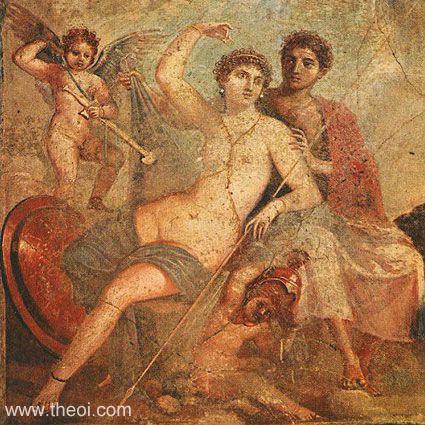
So much for the political message, but I think there’s a sexual message here too. Earlier and later works on the same theme (such as Poussin’s and a mural from Pompeii) show Cupid and cherubs playing with Mars’s weapons of war, symbols of profane, possibly illicit, but still human love. Botticelli on the other hand uses satyrs, traditionally representing boisterous and bestial untamed lust, two waving the lance around with gleeful abandon while another sneaks underneath him reaching for his sword. Sometimes Freudian analysis can be all too easily applied and while I certainly subscribe to the view that sometimes a lance is just a lance, I can’t help thinking that in this instance it probably isn’t.

Take this painting off the wall of the National Gallery and stick in the bedroom of a newly wed couple and the high-minded noble message of ‘Love conquers all’ gets a nudge nudge wink wink coda.

‘Love Conquers all (but sex never shuts up).”

It’s a beautifully painted, graceful, elegant and erotic incitement to pleasure, a seaside postcard of a painting with a subtle political sting in its tail. Go and stand in front of it and laugh – I’m sure the people it was painted for did.

(Tomorrow - back to the 21st Century and sunbathing.)